What are Photon Sources?
Photon sources are the cornerstone of quantum communication and cryptography systems — generating single photons or entangled photon pairs with precise control, enabling secure quantum key distribution and fundamental quantum experiments.
The Quantum Optical Heart of QKD Systems
Quantum communication protocols rely entirely on the precise generation and manipulation of photons — the fundamental carriers of quantum information. A photon source is not merely a light emitter; it is a highly engineered optical system designed to produce photons with specific, controlled quantum properties.
In quantum key distribution (QKD) and other quantum information protocols, two fundamentally different photon source types are employed: Weak Coherent Sources (WCS), which produce attenuated laser pulses approximating single-photon behaviour, and Entangled Photon Sources (EPS), which generate photon pairs whose quantum states are correlated regardless of separation distance.
Arquis engineers both source types to laboratory and deployment-grade specifications, enabling everything from fundamental Bell inequality tests to full fibre-based QKD networks operating at TRL-7 and beyond.
Polarization Control
Sources encode quantum information via photon polarization states — the basis of BB84 and E91 protocols — with high-fidelity beam splitting and wave-plate alignment.
Entanglement Quality
PPKTP and BBO crystal sources achieve entanglement fidelities exceeding 97%, validated through two-photon interference and quantum state tomography.
Plug & Play Integration
Ready-to-deploy form factors support both free-space and fibre-coupled operation for seamless integration into existing quantum lab infrastructure.
Essential Questions About Photon Sources
Technical answers explaining the differences, use cases, and practical considerations for quantum photon sources in QKD and research.
Arquis Photon Source Products
Explore the precision photon source systems available from Arquis for your quantum lab or QKD deployment.
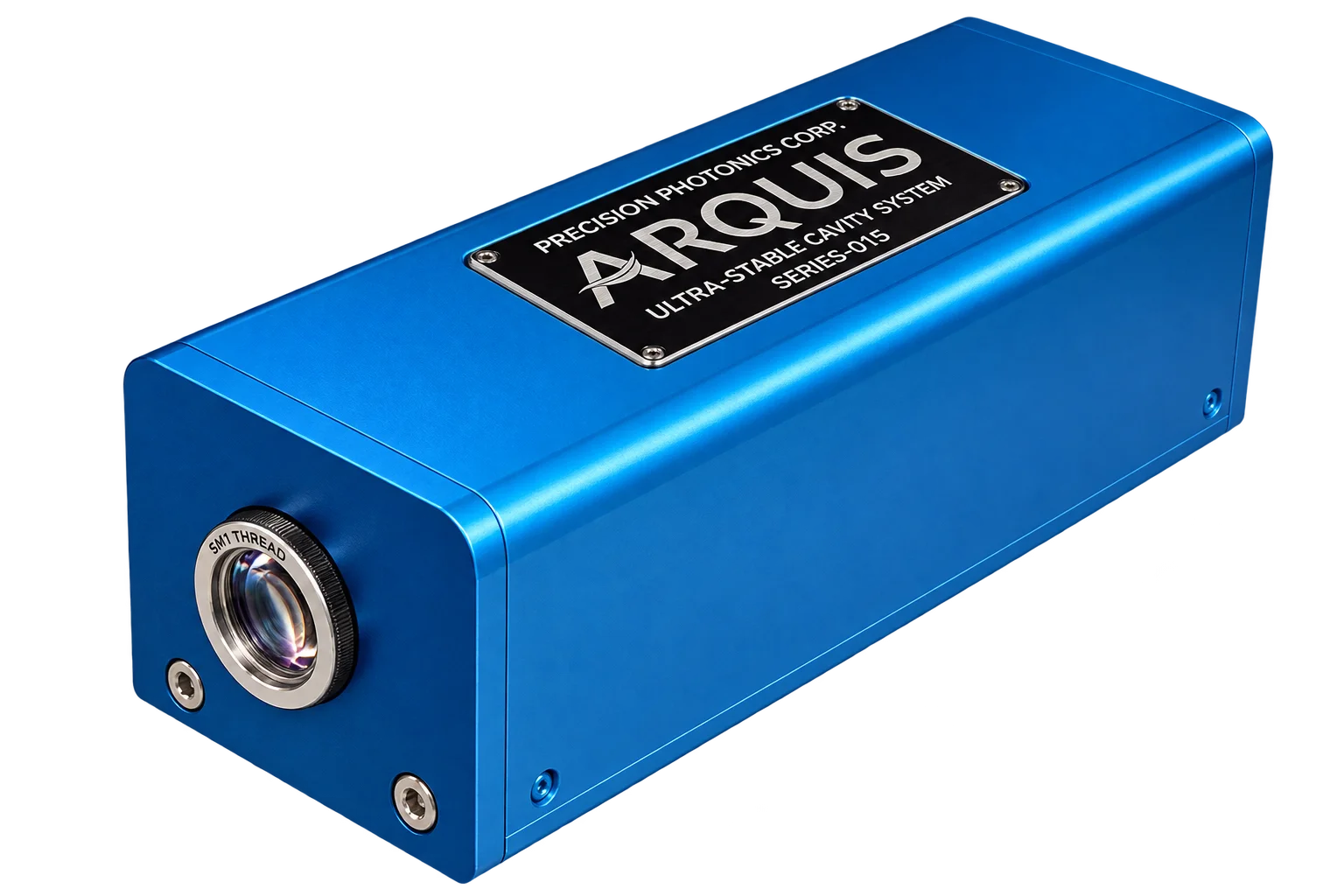
Weak Coherent & Entangled Photon Sources
High-brightness, ready-to-deploy EPS (TRL-7) and 800 MHz pulsed Weak Coherent Sources with QRNG-driven basis selection for BB84 QKD.
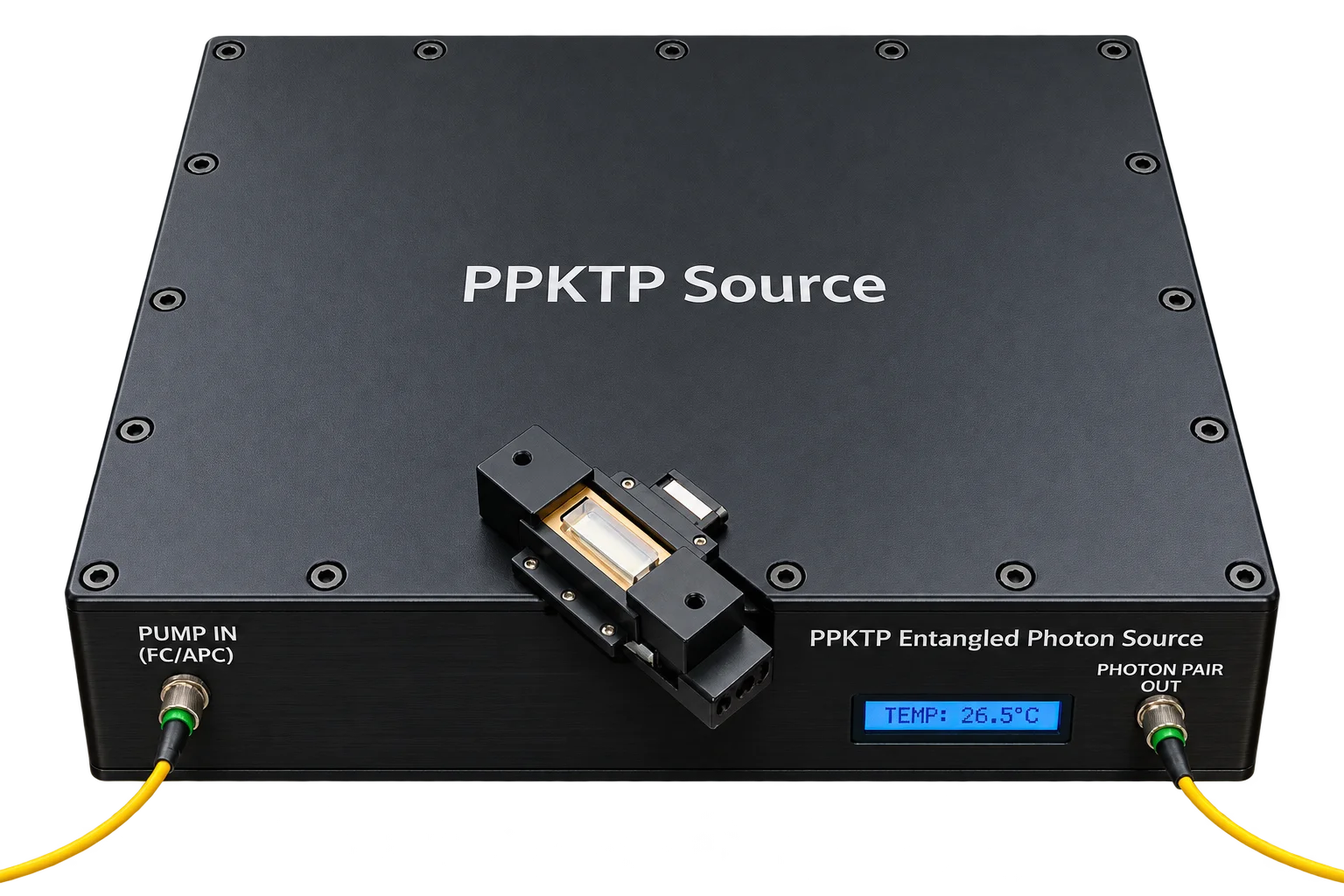
High-brightness PPKTP Sources
Ultra-bright entangled photon pairs via Type-0 PPKTP crystal with exceptional fidelity, visibility, and spectral brightness for advanced quantum experiments.