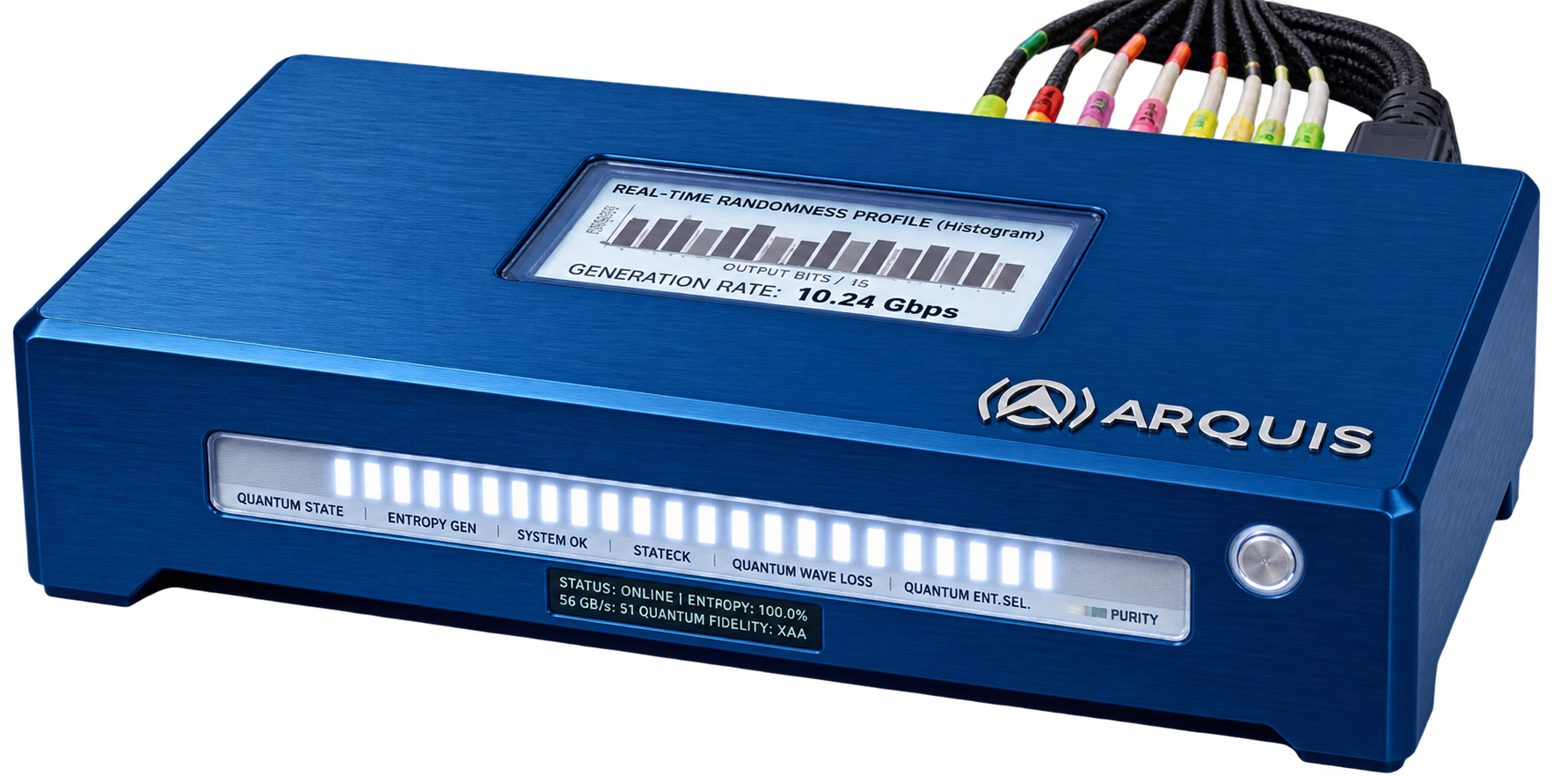
What is a QRNG?
A Quantum Random Number Generator (QRNG) harnesses the intrinsic indeterminism of quantum physics to produce provably unpredictable entropy for cryptographic integrity, post-quantum resilience, and stochastic compute.
True Unpredictability Rooted in Fundamental Physics
In modern computing and cryptographic architecture, randomness is not a peripheral utility—it is the indispensable foundation upon which all data confidentiality, digital identity, and communication security depend.
Conventional computers cannot generate genuine randomness because every CPU operation is deterministic. Standard software algorithms—known as Pseudo-Random Number Generators (PRNGs)—produce numbers that appear chaotic but are ultimately computable from an initial mathematical seed. With advances in quantum cryptanalysis and side-channel monitoring, deterministic seeds represent an existential vulnerability.
A Quantum Random Number Generator (QRNG) eliminates this vulnerability by measuring intrinsically probabilistic quantum processes, such as subatomic photon phase fluctuations and vacuum state variations. Because quantum mechanical events cannot be predicted even by an adversary with unbounded computational power, QRNG outputs provide information-theoretic unpredictability.
Quantum Entropy Source
Harvests real-time subatomic optical phase noise and spontaneous photon emissions rather than relying on mathematical state machines.
NIST SP 800-90B Health Tests
Integrated hardware monitors perform nanosecond-latency Repetition Count and Adaptive Proportion tests on every raw bit before cryptographic output.
Post-Quantum Resilience
Delivers the ultra-pure, high-entropy seeding required by lattice-based algorithms (NIST ML-KEM/Kyber, ML-DSA/Dilithium) to resist quantum attacks.
The Spectrum of Randomness: Deterministic vs Physical vs Quantum
In cryptography, cybersecurity, and stochastic compute, randomness is not a monolith. The term encompasses three fundamentally distinct technological architectures, each offering radically different levels of entropy, reproducibility, and resistance to attack.
The strength of any digital certificate, encryption key, session token, or Monte Carlo simulation depends on whether its entropy is generated algorithmically, harvested from ambient electronic noise, or derived from the non-deterministic laws of quantum mechanics.
PRNG (Pseudo-Random)
Generates sequences through deterministic recurrence equations (AES-CTR-DRBG, ChaCha20, Mersenne Twister). Extremely fast, but inherently periodic and vulnerable if the internal seed is exposed.
TRNG (Classical Physical)
Harvests analogue macroscopic entropy from circuit thermal noise, diode breakdown, or clock jitter. Non-algorithmic, but sensitive to ambient temperature drift and electromagnetic tampering.
QRNG (Quantum Physical)
Extracts entropy directly from quantum phenomena such as photon phase noise and vacuum state fluctuations. Intrinsically non-deterministic, mathematically proven, and continuously verifiable.
Comprehensive Architectural Comparison
| Dimension | PRNG (Algorithmic) | TRNG (Classical Physical) | QRNG (Quantum Physical) |
|---|---|---|---|
| Entropy Source | Mathematical seed state | Thermal noise, clock drift | Photonic phase & vacuum fluctuations |
| Determinism | 100% Deterministic | Macroscopically Chaotic | Intrinsically Indeterministic |
| State Compromise Risk | High (All past & future bits exposed) | Moderate (Thermal drift/bias) | Zero (Continuous quantum health check) |
| Throughput Capability | High (CPU bound) | Low to Moderate (1 - 100 Mbps) | Ultra-High (Multi-Gbps with Photonic RPU) |
| Post-Quantum Readiness | Vulnerable | Conditional | Recommended for PQC Standards |
| NIST Standards | NIST SP 800-90A | NIST SP 800-90B (Standard) | NIST SP 800-90B, BSI AIS 31 (PTG.3) |
Explore clear technical answers explaining how quantum randomness operates, why it is critical for security posture, and how it is validated.